# Create & Edit Alert Profile

### Access the Alert Settings:&#x20;

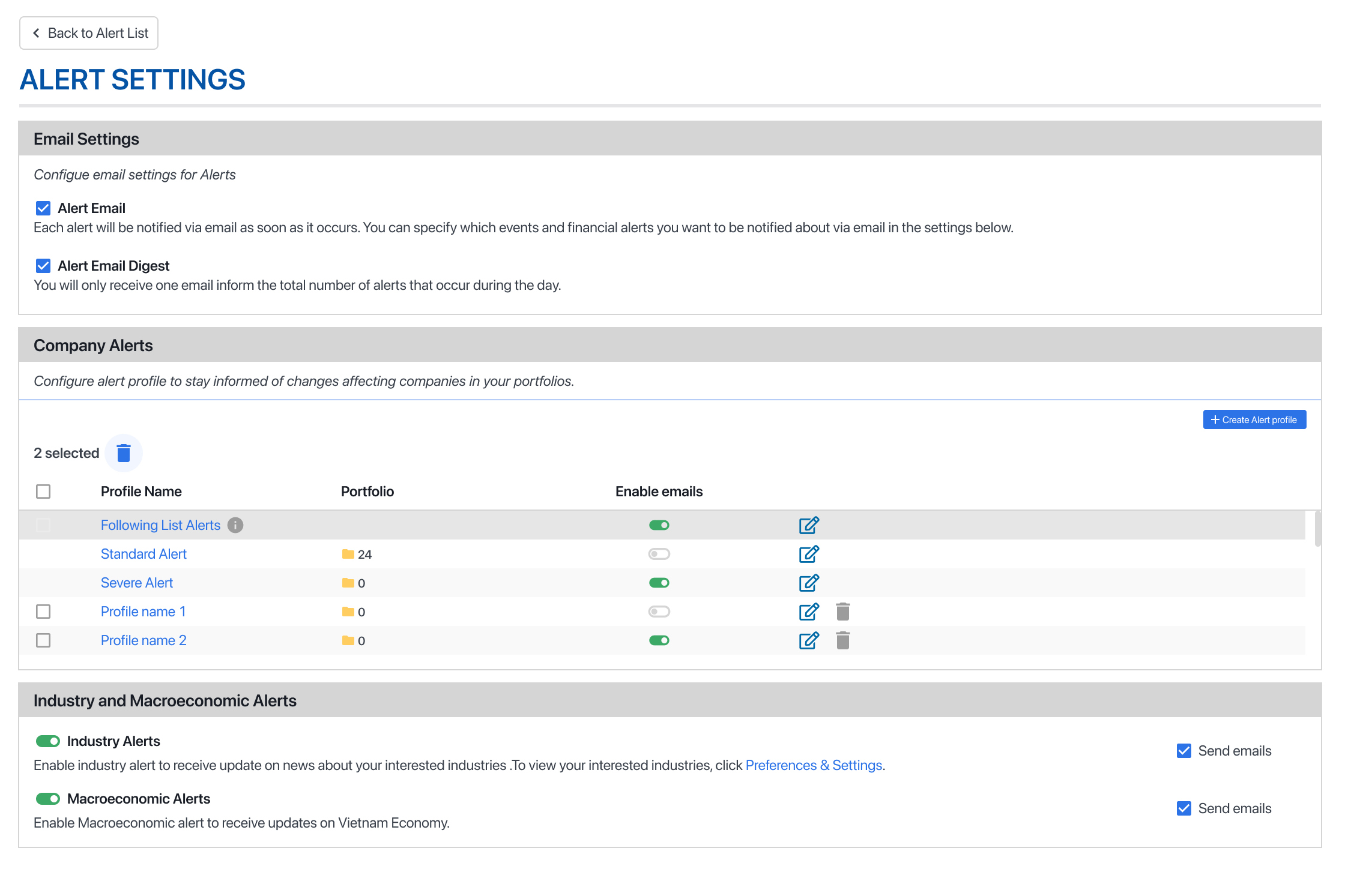
To access the Alert Settings screen, click on the "**Alerts**" section in the header bar. Once you're on the Alert List screen, locate and click on the "**Alert Settings**" button.

<figure><img src="/files/JjImDLYTmZd4QnM96SdR" alt=""><figcaption><p>Figure 1: Alert Settings screen</p></figcaption></figure>

### Alert Settings screen layout:

#### **1. Email Settings Panel:**&#x20;

The first panel you'll see is the "Email Settings." Here, you can configure your email preferences for receiving alerts. There are two options available:

* Alert Email: This option notifies you via email whenever each individual alert occurs.
* Alert Email Digest: With this option enabled, you'll receive a single email digest summarizing all the alerts that occurred during the day.

<figure><img src="/files/QC2nMzjIFpSBjNzGJIZh" alt=""><figcaption><p>Figure 2: Email Settings</p></figcaption></figure>

#### **2. Company Alert Panel:**&#x20;

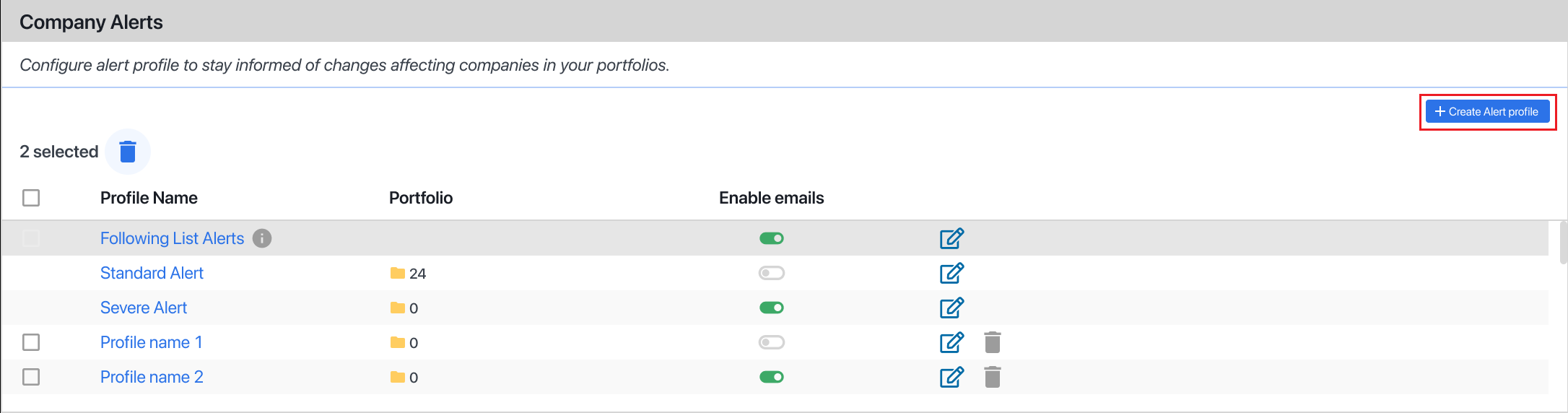
In this panel, you'll find a table that displays all the available alert profiles. The alert profiles provided by FiinGate include the Standard Alert, Severe Alert, and Following List Alert.&#x20;

<figure><img src="/files/usT0u0O6VlFd74FM6N2m" alt=""><figcaption><p>Figure 3: Conpany Alerts</p></figcaption></figure>

#### Configuring Alert Profiles:&#x20;

In the table, you can toggle the switches on or off to enable or disable email notifications for specific portfolios.&#x20;

* To remove a portfolio from an alert profile, simply click on the trash bin<img src="/files/RpktYIItnmPPLPKsDAgb" alt="" data-size="line"> icon next to it.&#x20;
* You can also click on the alert profile name or the <img src="/files/l6gdvU8WJFkPAuE3PuIk" alt="" data-size="line">icon to modify the settings of that alert profile.

For Premium Users, you can also create your own custom alert profile by clicking on the "**Create Alert Profile**" button.
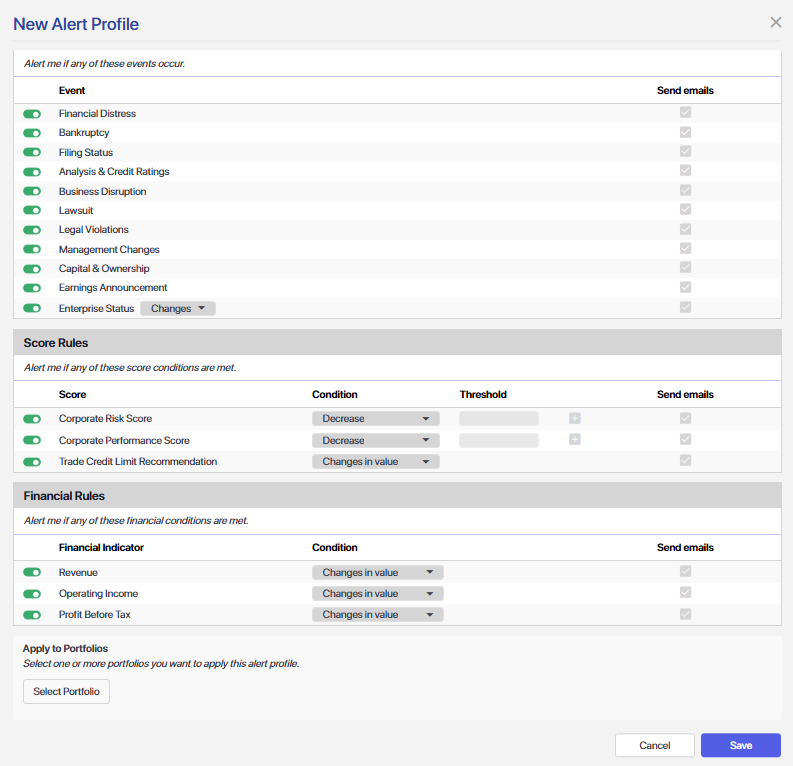
<figure><img src="/files/uN3vWk3Xe2oZvAXA7HGv" alt=""><figcaption><p>Figure 4: Create New Alert Profile</p></figcaption></figure>

#### How to create a new alert profile:

* Click on the "**Create Alert Profile**" button. A new window will appear, providing options for alert customization.
* Enter a name for the new alert profile. Users can select between two options: creating a new alert profile from scratch or creating it based on an existing profile.
* Toggle on: <img src="/files/hGFISq0PD0qmo2qrVKzp" alt="" data-size="line">or toggle off: <img src="/files/wKjxjXHODGaO07cwfQUv" alt="" data-size="line"> the events for which you want to receive alerts. There are three types of rules: Event rules, Score rules, and Financial rules. Configure these rules according to your preferences.
* Decide whether you want to receive email notifications for this profile by ticking <img src="/files/KRCruhUUoXhy2pOorShH" alt="" data-size="line">or unticking <img src="/files/VY6Tpa656x1q4Q6GZ8v7" alt="" data-size="line">the checkbox.
* If you want to apply this profile to an existing portfolio, click on the "**Select Portfolio**" button and choose the desired portfolio.

#### **3. Industry & Macroeconomics Alerts Panel:**

This panel allows you to toggle the switches on or off to receive or stop receiving alerts for specific industry and macroeconomic events. By enabling the switches, you will receive alerts related to those events.

<figure><img src="/files/RN8sJN8jAPIyqJA9ukRT" alt=""><figcaption><p>Figure 5: Industry &#x26; Macroeconomics Alerts</p></figcaption></figure>


---

# Agent Instructions: Querying This Documentation

If you need additional information that is not directly available in this page, you can query the documentation dynamically by asking a question.

Perform an HTTP GET request on the current page URL with the `ask` query parameter:

```
GET https://docs.fiingate.vn/manual/user-manual/alert-settings/create-and-edit-alert-profile.md?ask=<question>
```

The question should be specific, self-contained, and written in natural language.
The response will contain a direct answer to the question and relevant excerpts and sources from the documentation.

Use this mechanism when the answer is not explicitly present in the current page, you need clarification or additional context, or you want to retrieve related documentation sections.